

 LinkedIn
Most advice on getting cited in Google AI Overviews was written for a version of the product that no longer exists. I’ve seen this movie in paid search: Google changes how matching works, and practitioners keep selling control over the old mechanism.
Exact-match keywords gained close variants, then word-order flexibility, then same-intent matching. Phrase match absorbed broad match modifier. Through each shift, teams kept rebuilding granular single-keyword ad groups as if more meticulous grouping could reverse a change in the auction. We covered those expired habits in our breakdown of paid-search tactics that stopped working. Generative search is moving along a similar line, only faster.
A page has less control over where and how it appears in an AI answer than early citation playbooks assumed. The interface changed, the sources changed, and ads entered the answer itself. A long guide, a top-three organic ranking, and an FAQ schema block cannot force a citation. The dates matter because each turning point retired a different assumption. Here is what changed, what it broke for practitioners, and what remains worth doing.
May 2023: SGE Makes the Carousel Look Like the Prize
Google introduced Search Generative Experience, or SGE, as an opt-in Search Labs experiment at Google I/O on May 10, 2023. Its conspicuous answer box and three-card source carousel gave marketers something easy to photograph. They did not give anyone a settled model for measuring referral conversions, let alone attributable pipeline: access depended on a user joining the experiment and switching it on.
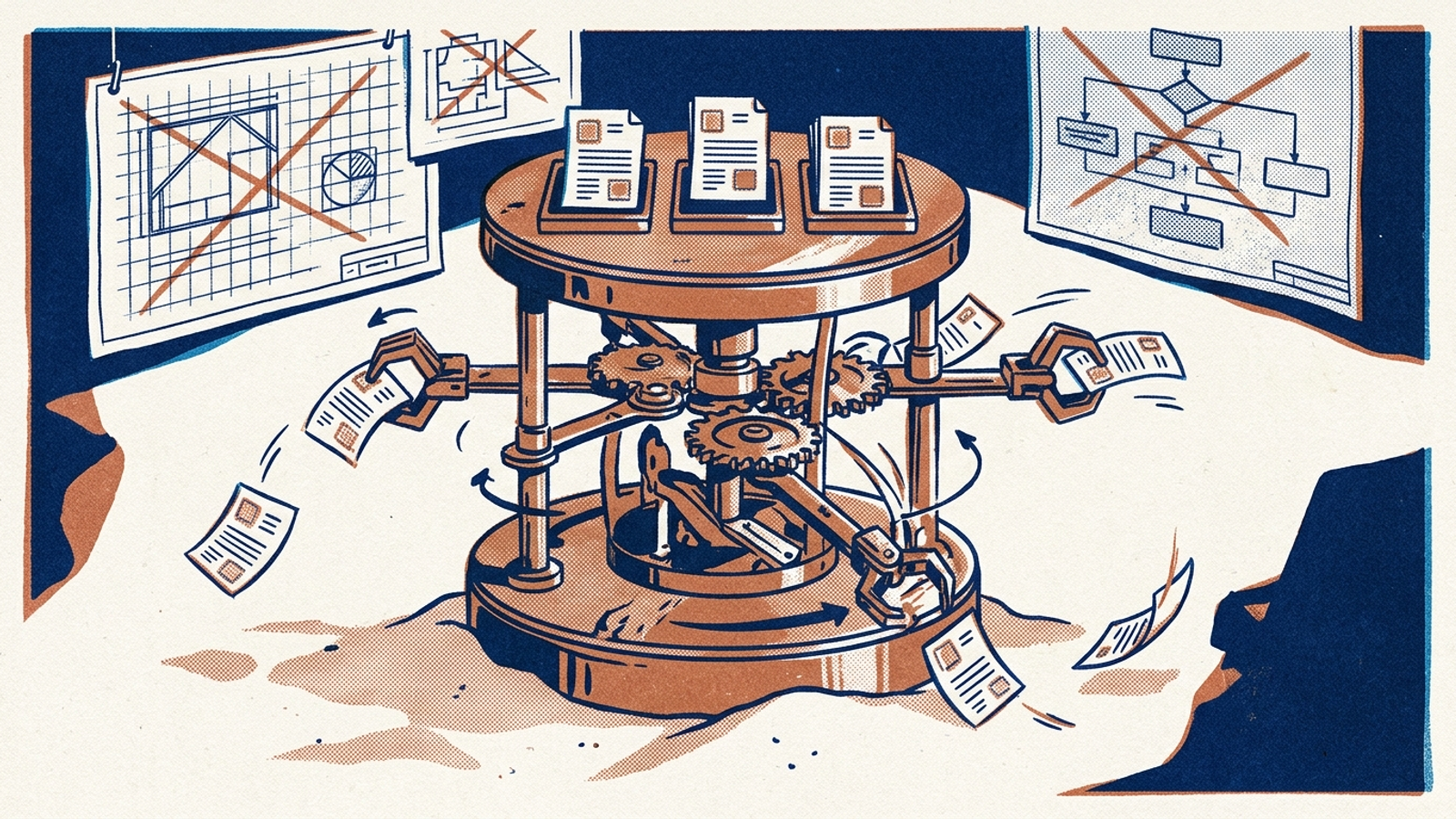
The first citation playbook nevertheless treated those cards as fixed real estate. Rank near the top of the ordinary results, the thinking went, and Google would summarize your page and put your domain in the carousel. From there came the familiar instructions: publish an exhaustive 4,000-word guide, add Schema.org FAQPage markup, and turn headings into questions that repeat the target keyword. It was old-school SEO wearing a new badge.
I understand why the advice caught on. A carousel has three visible slots; a ranking has a number; a screenshot makes either one look like a result. But a screenshot of a Labs experiment says little about whether a source earned useful attention or whether the same tactic would work after the interface changed. The error was treating one presentation of sources as a permanent selection rule.
That distinction matters even without pretending to know every detail of Google’s retrieval system. A page can contain a useful passage without ranking in the top three for the user’s exact wording. A high-ranking page can be too broad to answer the specific question an AI response is assembling. The practitioner’s job is to make the relevant information findable and intelligible, not to build an entire content calendar around three cards in an experimental layout. The carousel was a snapshot, not a specification.
May 2024: AI Overviews Go Public, Then Google Pulls Back
On May 14, 2024, Google moved beyond the Labs opt-in and rolled out AI Overviews to US searchers. That made the feature a live search surface rather than an experiment most customers would never see. It also made its failures impossible to ignore. Widely shared examples showed answers suggesting glue on pizza and rocks as food. Neither was the sort of product demonstration anyone had ordered.
On May 30, Google VP of Search Elizabeth Reid explained that some failures involved thin information environments and satirical forum material. Google tightened when AI Overviews would appear and how they handled sensitive or unreliable material. The practical lesson was immediate: a citation plan built on the assumption that an overview would appear for every target query had a problem before source selection even began. First the answer has to appear.
This broke a reporting habit that had grown around SGE. Teams could count appearances in experimental answer boxes or show a client a promising screenshot. Once the feature reached a broader audience and Google adjusted its triggers, that was not enough. You needed to know which queries actually produced an overview, whether your brand appeared, and whether that appearance contributed anything beyond a line in a slide deck. The ordinary result page had not disappeared; a query could still send a searcher through conventional links instead.
The episode also changed the meaning of “more AI visibility.” More answer boxes are not automatically better if the answers are unreliable. Google had an obvious reason to restrict a format that could put nonsense at the top of the page. For practitioners, the fix was not another markup trick. It was to stop budgeting against a static display frequency and start treating the presence of an AI answer as a variable. Check the live surface before optimizing for its furniture.
October 2024: Source Links Evolve, and Ads Enter the Answer
By October 2024, Google was expanding AI Overviews to more than 100 countries and changing how people encountered links to supporting pages. The neat three-card mental model from SGE was a poor guide to a developing interface. If your entire measurement plan depended on occupying a particular carousel slot, you had optimized for the container rather than the reason someone might use your source.
That reason is often specific. A comparison, specification, or direct explanation can be useful to an answer even when it sits inside a larger page. Conversely, a 3,000-word post can be comprehensive and still make the useful sentence hard to find. Write the answer where a reader would look for it, then earn the depth that follows. A heading that names the subject and a direct passage beneath it do more practical work than three paragraphs announcing that the topic is important.
October brought a second change that organic-only citation plans could not format their way around: Google introduced ads in AI Overviews on mobile in the US. Advertisers did not need to create a dedicated AI Overview campaign for their existing eligible Search, Shopping, and Performance Max ads to be considered. Google says ads can appear above, below, or within AI Overviews, depending on relevance to the query and response.
That does not mean every commercial overview contains an ad, or that buying one secures an organic citation. It means the answer box stopped being territory you could sensibly describe as purely organic. We discussed the commercial implications in our look at the closing window for organic citations. For an operator responsible for revenue, the distinction is straightforward: a citation and a sponsored placement solve different problems, and both can compete for attention in the same search experience.
Consider the work behind a high-intent software comparison. A content team may explain the trade-offs well enough to be cited. A paid-search team may have relevant ads eligible alongside that answer. If those teams report separately, one celebrates a mention while the other misses a change in where demand is being captured. Measure the commercial result across the surface, not just the citation inside it. That is what the arrival of ads fixed in the old playbook: the illusion that winning a source link was the whole job.
2025: AI Mode Makes the Original Keyword a Smaller Target
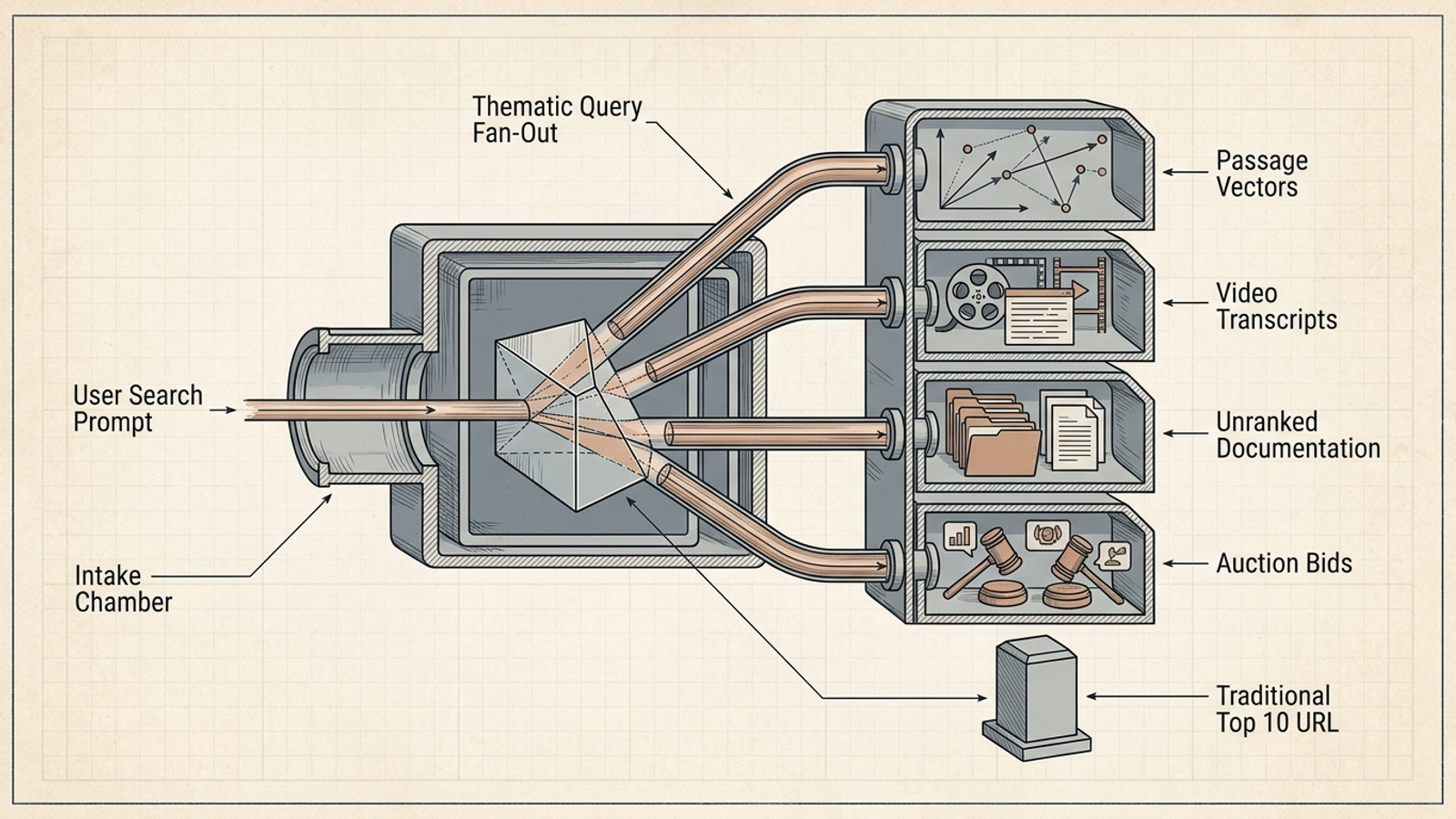
AI Mode pushed the problem beyond where links sat on a results page. Google’s conversational search experience made room for a more involved response to a more involved question. The relevant idea for practitioners is query fan-out: instead of relying only on the user’s original wording, a system can explore related questions and retrieve material that answers different parts of the request. Analysis of Google’s thematic-search patent helps explain the approach, though a patent is not a map of every live retrieval decision.
Take a prompt comparing commercial fleet dashcams for cold-weather reliability. The person asking it has not supplied one tidy keyword that covers every relevant detail. Battery behavior, connectivity, and mounting hardware might each matter to the answer. A page built solely to rank for “best fleet dashcams” may not be the clearest source on any of them. The primary keyword is no longer a reliable boundary around the citation opportunity.
The overlap data is another reason to retire the top-10 prerequisite, not a reason to promise citations to pages that rank lower. In September 2025, BrightEdge reported limited overlap between AI citations and the top organic positions in its tracked results. A separate Ahrefs study of AI Overview citations found that 38% of cited URLs ranked in the organic top 10 for the same query. Those studies have their own methods, but they point in the same practical direction: ranking on page one can help a page get seen; it is not an admission ticket to the answer.
The traffic case deserves the same skepticism. Semrush’s analysis of AI Mode sessions found a 92% to 94% zero-click rate in the interactions it examined. That figure describes AI Mode, not every AI Overview or every search. Still, it is a poor basis for selling citations as a one-for-one replacement for organic visits. A source mention may corroborate your brand while the searcher gets enough information without clicking. If you call every mention a traffic win, you will eventually have to explain the traffic.
This is where I would date-check any proposed citation work. The following audit is deliberately short; each item should survive a change in how Google displays the answer, or be retired with the interface it assumed.
Citation audit: retire the old levers, keep the durable work
Retire:
- Fixed-carousel targets. A slot in the SGE layout is not a lasting optimization objective.
- Top-10 ranking as a prerequisite. Check the actual sources used; do not wait for page one before making a useful passage clear.
- Keyword-stuffed FAQ schema. Markup cannot make an unhelpful answer worth citing.
- 4,000-word guides written for their length. Put the specific answer near its heading; add detail because it helps the reader.
- Organic-only commercial plans. An ad and a citation can occupy the same search experience.
Keep:
- Direct, answer-first passages under descriptive headings.
- Consistent company, product, and people details wherever they appear on the web.
- Paid-search assets and Shopping feeds aligned with the commercial queries you care about.
- Crawl and rendering checks. This is the item teams most often skip: if Google cannot reliably access the useful part of a page, better prose and schema cannot rescue its citation prospects.
Early 2026: Treat Citation Advice as a Dated Operating Assumption
The timeline ends in the present, not with a permanent recipe. SGE made a carousel look like the target. The public AI Overviews rollout showed that Google could change when an answer appeared at all. Ads changed the commercial value of the space. AI Mode made a user’s original keyword less useful as a complete map of what sources the answer might draw on. Each turn narrowed what page-level tactics alone could control.
That does not make content irrelevant. It makes crawlable structure and clear entities more valuable than imitation of a temporary interface. Say plainly what a page covers. Make the answer easy to locate. Keep product details consistent. Check that Google can access the page. Then watch what happens to qualified traffic and pipeline, rather than awarding yourself a victory every time a domain name appears in an answer.
The paid-search analogy has a limit: a citation is not an ad impression, and an organic page is not a keyword match type. The shared mistake is more useful than a perfect analogy. When the matching layer changes, practitioners can spend months rebuilding an old lever with greater precision. I would rather spend that time on the inputs that remain legible to both a search system and a customer.
That is also why we built groas around continuous execution across paid and organic search, with specialized AI models doing the ongoing work and a named human strategist setting direction and guardrails. A flat monthly fee, no setup fee, and month-to-month terms are an alternative to paying for manual busywork simply because it fills a retainer. No operating model can guarantee an AI citation, and I would distrust one that says it can. The next interface change is the reason to build an approach that can respond to what Google actually shows, not another expensive blueprint for the last version of the answer box.