

 LinkedIn
A better paragraph will not earn your business a citation if the answer engine cannot reach the page. I used to tell clients to rewrite first. I was wrong.
Fix access and retrievability first, answer-first content second, and outside mentions third. Most AI-citation advice starts at step two. This guide starts where a citation starts: with a page that can enter the candidate pool.
How does a page become a citation?
Say you run a garage door company spending $20k a month on search, and someone asks ChatGPT for an installer in your city. Before your price, response time, or service area can influence the answer, the system needs a way to find that information. That is the first principle. A page outside the retrieval path cannot win on better wording.
ChatGPT may answer from parametric memory—information learned during training—or use search to bring in current pages. A memory-based answer can name businesses without checking their live pages. A search-backed answer can provide clickable sources. The distinction matters if you are measuring citations rather than whether your name appears in a response. See how browsing and memory answers differ.
Perplexity is more consistently retrieval-led. It draws candidates from an index, reranks them for factors including relevance, quality, and freshness, then writes an answer with inline citations. Its answer may contain more cited sources than a ChatGPT answer, but the same gate applies: your page has to become a usable candidate before its prose can help. This breakdown of Perplexity’s retrieval and reranking explains the path.
That gives our garage door company an order of operations. First, let the relevant bots reach its pages. Next, make sure the pages can be retrieved from search indexes and read without a browser doing extra work. Only then polish the passage about spring replacement. It is less glamorous than rewriting every H2. It is also the order in which the system encounters the work.
Which bots need access?
OpenAI uses different agents for different jobs. GPTBot is associated with training. OAI-SearchBot is used for search discovery. ChatGPT-User can fetch a page in response to a user request. Blocking GPTBot is not the same choice as blocking the agents that help search-backed answers find or read your site. The crawler distinctions matter when you write rules for them.
Perplexity also distinguishes PerplexityBot, which helps build its index, from Perplexity-User, which fetches in response to a user request. Those agents may not behave identically around robots.txt, so a robots rule alone is not a complete access test. The difference between Perplexity’s bots is worth understanding before you block one.
Then there is the search index behind an answer. ChatGPT can rewrite a question into narrower searches, and Bing visibility can matter to whether your page turns up. Analyses of citation overlap have reported very different figures, including one showing substantial overlap with Bing’s top results and another showing little. I would not turn either into a promise that every ChatGPT citation comes from Bing. I would treat Bing indexing as a practical check, not an optional bit of housekeeping. If your money page is missing there, fix that before betting on a copy edit. The citation-overlap figures show why a single backend assumption is too neat.
Step 1: Can the citing bots get through the door?
Start with robots.txt, then check what your security stack actually serves. A permissive robots file does not help if a CDN or firewall returns a 403 first.
- Check the relevant agents:
OAI-SearchBot,ChatGPT-User,PerplexityBot, andPerplexity-User. Do not lump them together withGPTBotjust because their names contain AI-related terms. - Look for broad blocks: a wildcard
Disallow: /, a CDN bot preset, or a WordPress security rule can catch more than its owner intended. - Make the training choice separately: disallow
GPTBotif you want that opt-out; do not assume the same rule belongs on search and user-fetch agents.
I have seen the underlying mistake in plenty of search work: someone tries to stop one kind of automated traffic and blocks the useful traffic too. If you need syntax, use the AI crawler swipe file rather than guessing at user-agent names.

Do not stop at the file. Check whether your CDN, firewall, or security plugin denies the agents before they reach it. A successful Googlebot fetch in Search Console does not prove an OpenAI or Perplexity agent receives the same response. For our garage door site, the useful question is not “Does the homepage work in my browser?” It is “What response does the relevant bot get for the spring-replacement URL?”
Then check that URL in Bing Webmaster Tools. A crawlable page and an indexed page are different things. Access gets the bot in; indexing helps the page get found again. If the page fails either check, skip the rewrite for now.
Step 2: Is there anything usable behind the door?
A 200 response is good news only if the response contains the facts you want cited. I check the page source as well as the rendered page. If the service list, hours, service area, or prices appear only after JavaScript runs, a fetcher may get the shell and move on. Rendering can make a page look complete to you while leaving a thin response for a bot.
Keep the important facts in plain HTML. Give a service or location a clear URL, use an appropriate canonical, and include the URLs you want found in a current sitemap submitted to Bing Webmaster Tools. If several location pages mostly duplicate one another, do not assume the index will keep every version. For the garage door company, a spring-replacement page needs to stand on its own rather than depend on a script, a menu interaction, or another city page to explain what it offers.
Also check the ordinary obstacles that compound the problem: a slow response, an oversized page, or a money page buried several clicks deep. The draft’s working targets are a server response under two seconds, a main page under about 2MB, and money pages within two clicks of the homepage through plain links. These are useful checks, not magic thresholds. The aim is a page a fetcher can reach and understand without extra steps.
Skip rebuilding a page that already fetches cleanly and ranks for its target query. Move to the answer itself. If it does not pass these checks, a sharper opening paragraph will not repair the route to it.
Step 3: Can one passage answer the buyer’s question?
Now the writing matters. A citation usually points to a page, but the answer is assembled from a smaller piece of it. Make that piece understandable on its own.
For our garage door company, put its price range, response time, and service area near the top in plain sentences. Then give each buyer question a direct heading and answer. Under “How much does garage door spring replacement cost in Dallas?”, a short passage can state the range, what changes it, and whether there is a callout fee. The numbers must match what the business actually charges. An answer that needs three other sections to explain it is harder to lift accurately.
A simple structure does more work than a clever introduction:
- Answer the question first. Do not make a buyer read a story before finding the service area or price.
- Separate the follow-up questions. Give timing, scope, and pricing their own clear sections.
- Use a table when comparison helps. Service, price range, and typical time on site are easier to scan together than buried across paragraphs.
- Keep repeated facts consistent. An FAQ can restate the same numbers, but it should not quietly introduce a second price or turnaround.
The passage-format research collected here points toward early, direct answers, question-led sections, tables, and sourced specifics. I would not build a page around a supposedly perfect word count. The mechanism is simpler: a self-contained answer gives the engine less to reconstruct and the reader less to hunt for.
Step 4: Will the answer know which business you are?
Suppose the homepage says “Apex Garage Door,” a business profile says “Apex Garage Doors Dallas,” and the About page has an old phone number. A person may work out that these refer to the same company. A system comparing sources has to reconcile the mismatch before it can confidently name the business.
Pick the business name you actually use and make the core facts agree across your site, Google profile, Bing Places, and relevant directories: name, address, phone number, category, hours, and service area. Add appropriate Organization and LocalBusiness schema, with sameAs links to the profiles the business maintains. Keep licenses, founding year, and other facts consistent wherever you publish them. This discussion of corroborating business signals makes the point: outside sources are more useful when they clearly describe the same entity.
Do this before asking for more mentions. Otherwise, the garage door company may earn attention under several slightly different names while its own pages disagree about the basics. If the facts conflict on pages you control, fix those pages first.
Step 5: Who else confirms what your page says?
Once the page is accessible, retrievable, and clear, outside mentions have a job. They help corroborate that this business does this work in this place. For Perplexity in particular, its mix of cited sources includes social and discussion sites as well as conventional publications. The Perplexity source breakdown puts substantial weight on Reddit and other social sources. That does not mean posting five generic guest articles or manufacturing a conversation.
For the garage door company, a specific customer review says more than “Great service.” A genuine discussion of the work, a walkthrough, or a local mention can give the answer another source that agrees with the company’s own page. The details have to be real. A made-up price placed in a review is not corroboration; it is a second version of the company’s claim wearing a different jacket.
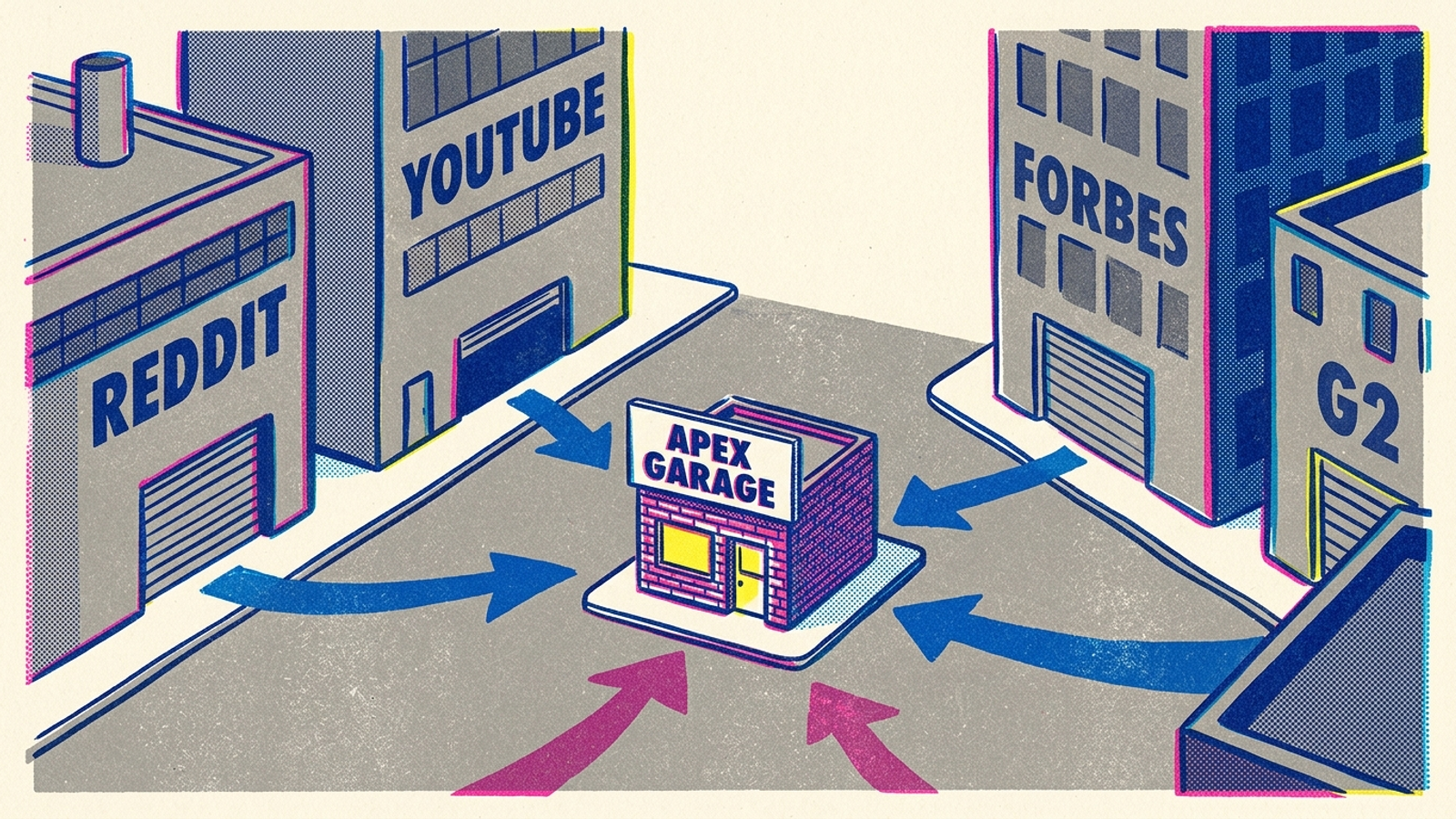
Earn mentions that confirm useful facts, not merely more instances of your brand name. Skip the generic brand posts that answer no buyer question and add no independent detail. Outside proof is the third layer, not a substitute for a page the engine can read.
Step 6: Were you fetched, cited, or merely named?
A brand mention is not a citation, and one prompt is not a trend. Choose five buyer questions. Run each three times in fresh sessions over two weeks, record the date, and count clickable citations to your URL separately from mentions of the business. Keep the questions the same when you test a change. Otherwise, you are comparing different searches and calling the result progress.
Then inspect 30 days of server logs for OAI-SearchBot, ChatGPT-User, PerplexityBot, and Perplexity-User. Verify apparent bot traffic against the vendors’ published ranges; a user-agent string alone can be spoofed. A cited page will not necessarily receive an on-demand fetch while the answer is written. It may have been crawled for an index earlier. That is why the sequence of log entries matters. This teardown of 30 days of AI crawler logs shows what fetched pages look like in practice.
Use the checks to decide what to do next:
- No verified fetch and a blocked response? Go back to Step 1.
- A clean fetch, but the page is missing from the relevant index? Go back to Step 2.
- A retrievable page with no citation? Revisit the answer passage and the evidence around it before writing more pages.
- A brand mention without a link to your URL? Record it as a mention. Do not count it as a citation.
Give a fix 14 to 21 days before rerunning the same prompt set, and change one thing at a time where you can. If Perplexity cites the garage door page and ChatGPT does not, check Bing coverage rather than assuming the copy failed. If neither cites it, but the logs show clean fetches, look at what the page actually answers. Diagnose the failed layer instead of restarting at content every time.
What should I do differently for ChatGPT and Perplexity?
Keep the shared foundation: accessible pages, clear HTML, consistent business facts, and answers that stand alone. Then pay attention to the difference in how the engines find candidates.
For ChatGPT search visibility, check Bing indexing and make the garage door page’s title and subject literal enough to match the searches a buyer might make. Keep the page stable and its facts current. For Perplexity, which reranks retrieved material with freshness and outside agreement in the mix, keep relevant proof current and seek specific, genuine third-party mentions. Neither task requires a generic brand blog post that fails to answer a customer’s question.
Do not mistake those differences for separate strategies. Both engines need something worth retrieving before either needs a new slogan.
What is the tradeoff, and what do I do today?
Blocking GPTBot is a training choice. Blocking search-discovery or user-fetch agents can also limit the routes by which your pages reach cited answers. I would not make those decisions with one blanket “block AI” rule. It is the sort of shortcut that saves a few minutes now and creates weeks of confused diagnosis later.
The ongoing work is real: checking access, watching what gets fetched, and measuring citations against the same buyer questions. It resembles the 1am negative-keyword mining I used to do: useful, repeatable, and not where a human strategist should spend all their time. groas puts autonomous execution to work across paid and organic search while a named strategist owns direction and accountability. The point is to act on measured outcomes, not admire a dashboard.
Open two tabs today: yoursite.com/robots.txt and Bing Webmaster Tools. Check the rules for the four search and user-fetch agents, keep the GPTBot training decision separate, then confirm your money URL is indexed. Do that before you rewrite a single paragraph.