

 LinkedIn
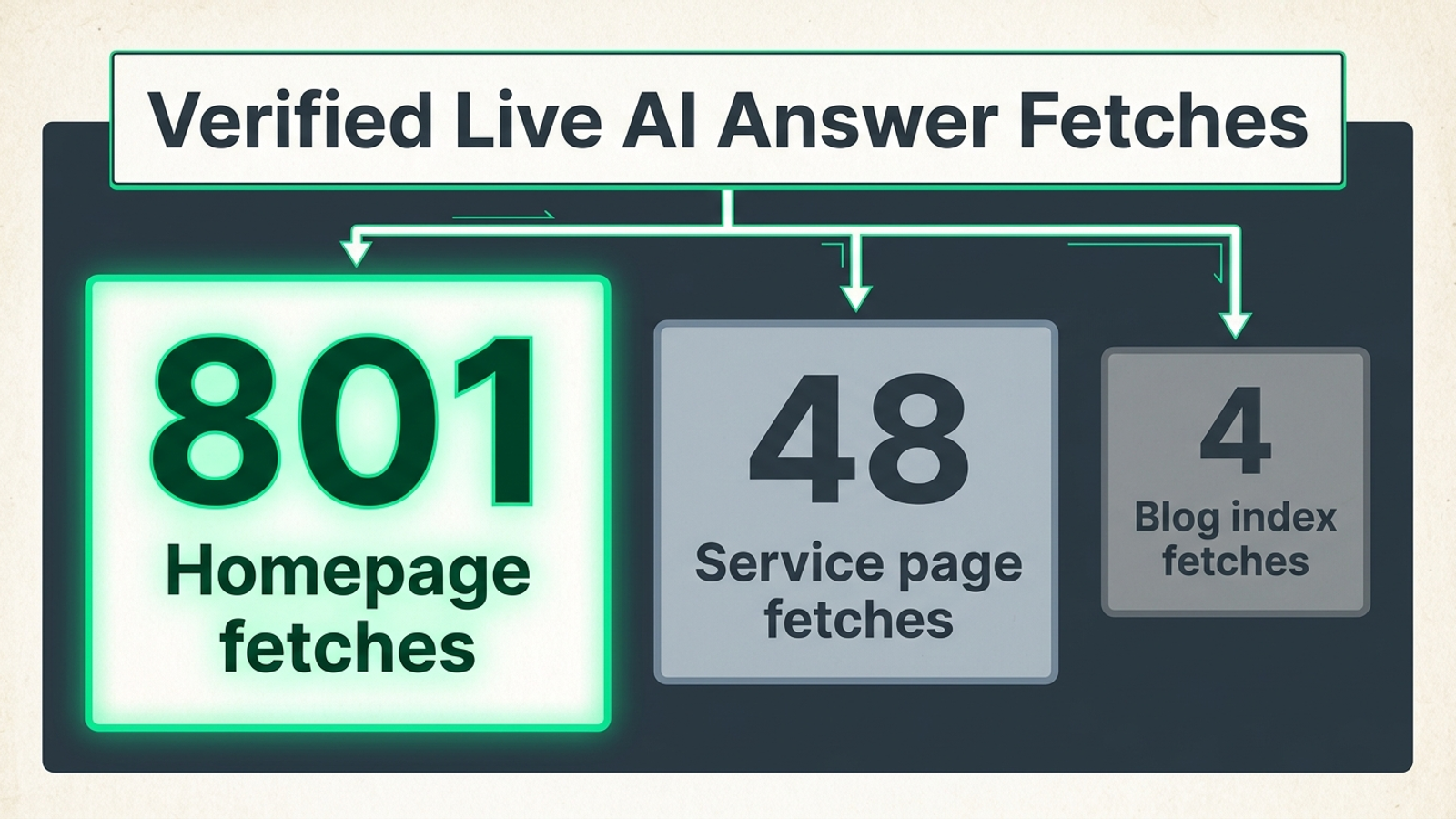
In 30 days, verified live-answer bots fetched the groas homepage 801 times and the /blog index four times. If an agency wants to sell you forty question-shaped posts to get cited in ChatGPT and Perplexity, make it explain that gap before you sign.
Our edge logs also recorded 48 fetches for /for-businesses and 22 for /for-agencies. Those requests do not prove we were cited, and four visits to the blog index do not mean four visits to every article. They do show where live-answer bots went in this window. The homepage received roughly 200 times as many fetches as the blog index. Fix the pages an assistant opens when a buyer asks about you before you commission post number fifty.
The usual AEO pitch points in the opposite direction: leave the primary site alone and churn out keyword-stuffed Q&A articles. That is old long-tail SEO wearing a new badge. When a buyer asks who you are, what you deliver, or what you charge, an assistant needs current facts about your business. A generic explainer about the category cannot supply them.
The FAQ-post pitch sells an old search habit
I understand why the pitch works. For years, performance marketers learned to find a long-tail query, build a dedicated URL, put the phrase in an H2, and wait for impressions. When ChatGPT and Perplexity appeared, some agency decks crossed out “SEO” and wrote “AEO.” The prescription remained familiar: publish a cluster of 50 to 100 question-and-answer posts, add FAQ schema, and wait for citations.
The problem is not that assistants never read articles. It is that publishing more definitions does not answer a buyer’s question about your company. If someone asks what customer acquisition cost means, a polished 800-word post on your site gives the assistant little reason to name you. Practitioners discussing citation tests in r/SEO describe the frustration: the articles exist, but the company still goes unmentioned.
I used to give clients a softer version of this advice. I thought assistants would work through informational hubs looking for quotable definitions and give the business some secondary attribution. Then we looked at where live retrieval requests actually landed. Do not buy a content calendar because its logic sounds familiar. Check the destination.
What 30 days of edge logs show—and what they do not
We reviewed 30 days of raw edge logs for masonandfinch.com, separated background indexing from live-answer requests, and checked AI bot traffic against verification signals. That left a narrower question than “How visible are we in AI search?” It told us which pages verified live-answer bots requested during the window.
OpenAI describes ChatGPT-User as a bot used for user-initiated actions, rather than general-purpose crawling. Our table also includes the identified live-answer requests from other assistants. These are fetch counts, not citation counts; they cannot tell us what the assistant said to a user or whether it named groas.
| Endpoint | Page type | Verified live-answer fetches, 30 days | Identified agents |
|---|---|---|---|
/ | Homepage | 801 | ChatGPT-User (753); Claude / Perplexity (48) |
/for-businesses | Core commercial page | 48 | ChatGPT-User (42); Perplexity (6) |
/for-agencies | Secondary commercial page | 22 | ChatGPT-User (19); Perplexity (3) |
/blog | Editorial index | 4 | ChatGPT-User (4) |
Source: groas internal edge-log review for the 30-day monitoring window. These counts are for the listed endpoints, not an inventory of all article URLs.
First, throw out the bot-traffic noise
A raw access log is a poor AEO report. User-agent strings can be spoofed; DataDome’s research on ChatGPT-User bot traffic explains why an AI-looking request is not automatically a genuine assistant visit. We used reverse DNS checks and IP-range validation against published OpenAI ranges and found that 76.5% of the AI bot traffic in our logs could not be verified. That figure describes our traffic, not every site’s. It is enough to make a dashboard full of unverified “AI visits” a lousy basis for an editorial budget.
After verification, the pattern was hard to miss: 801 homepage requests against four for the blog index. A request to /blog is not a request to each post beneath it. Still, the result is a direct challenge to the idea that an expanding index of FAQs should be the first place a vendor spends its AEO money.
The article that broke the pattern
One groas post did attract sustained live-answer attention. In Postmortem: 402 Live-Answer Fetches for One Post, Zero for Its Neighbour, we documented 402 live-answer requests for a single article in under 72 hours while an adjacent post received none. It was a technical teardown of a recent ad-platform change, with raw packet headers, dated screenshots, and proprietary auction data published four hours after the update went live.
That post was not another evergreen answer to a basic question. It offered primary material about a recent event. The exception argues for reporting something useful, not manufacturing forty variants of the same FAQ. If your agency can produce that sort of work, talk about it. If it is quoting a bulk rate for definitions, do not confuse the two.
A buyer needs facts about you, not another category explainer
Think about the prompts a prospective customer might use: “Who handles autonomous Google Ads for mid-market ecommerce?” “How does groas structure pricing?” “What are the commercial terms for hiring groas versus an agency?” These are qualification questions. An assistant answering them needs current information about the vendor. It will not find your billing model in a post explaining the definition of ROAS.
Other research gives this distinction some useful context, though it does not turn our fetch log into a citation study. In an analysis of 31,200 vendor URLs retrieved by ChatGPT, pricing pages had a 34.5% citation rate and product feature pages 24.8%. Blog posts in that analysis turned a retrieval into a citation at 6.1%; whitepapers and gated PDFs were at 1.2%. Those are figures from that study, not rates measured on masonandfinch.com. The practical point survives the distinction: being fetched is an audition; the page still has to answer the question.
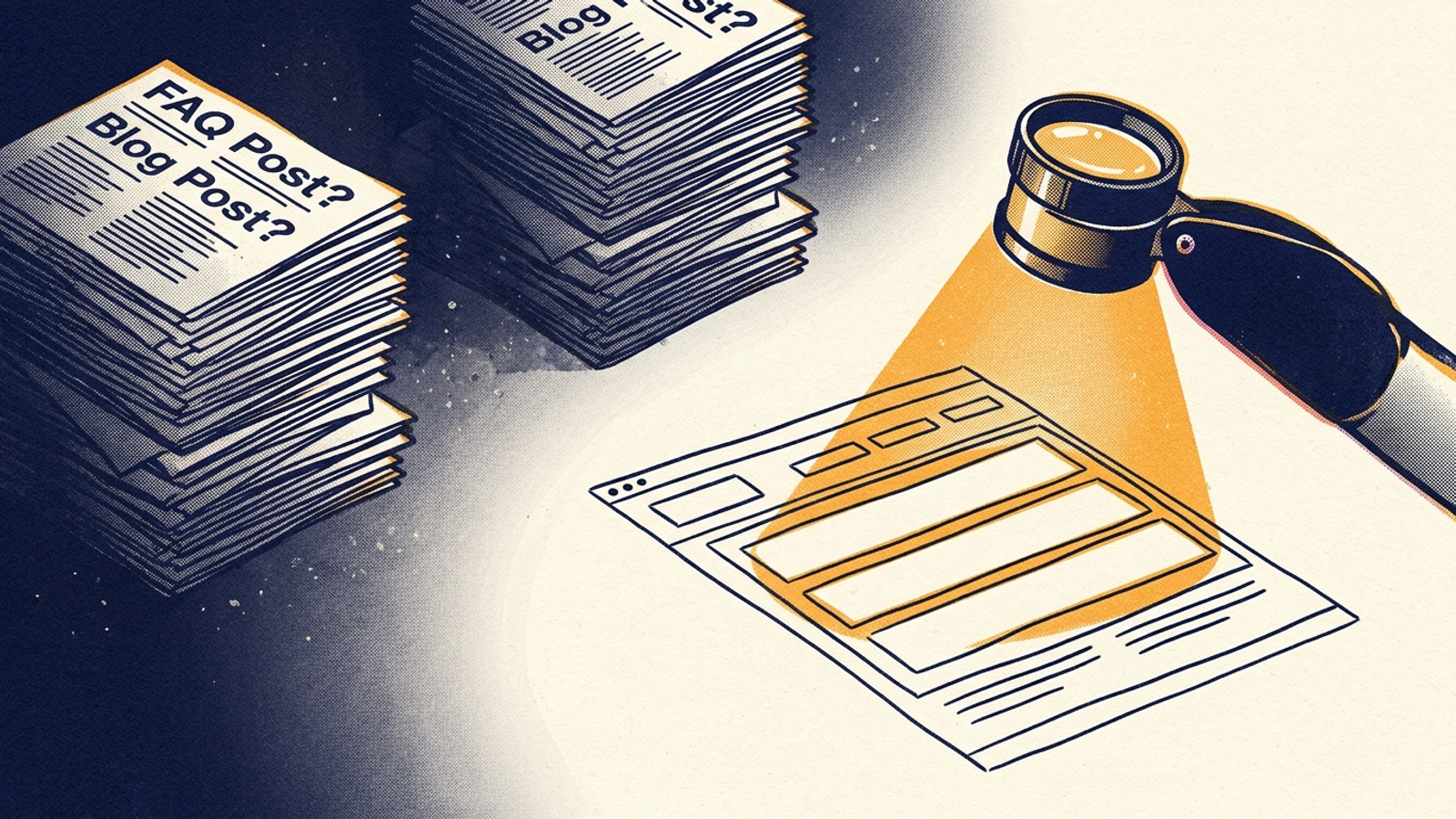
Citation durability matters too. In a 17-week study of 82,619 prompts, SISTRIX found 74% weekly turnover among generic informational citations. For 43% of branded queries, the business’s own primary domain stayed cited across the four-month test. Those results do not promise a permanent place in an answer. They do make a homepage full of vague slogans look like an expensive omission when the buyer is asking about your business by name.
Spend the AEO budget on the pages that carry the sale
This is not a request to sprinkle “AI-friendly” into your headings. It is a request to put usable commercial facts where a visitor—or an assistant—can find them. Start with the homepage, move to service and pricing pages, then write an article only when you have a specific gap to fill.
1. Make the homepage answer the qualification questions
In an examination of 1.4 million ChatGPT prompts, Ahrefs found that brand-owned websites accounted for 13% of total citations. You do not control every source an assistant uses. You do control whether your own homepage gives it a straight answer when it arrives.
Read the page as a skeptical buyer would. Can you find these answers without booking a call?
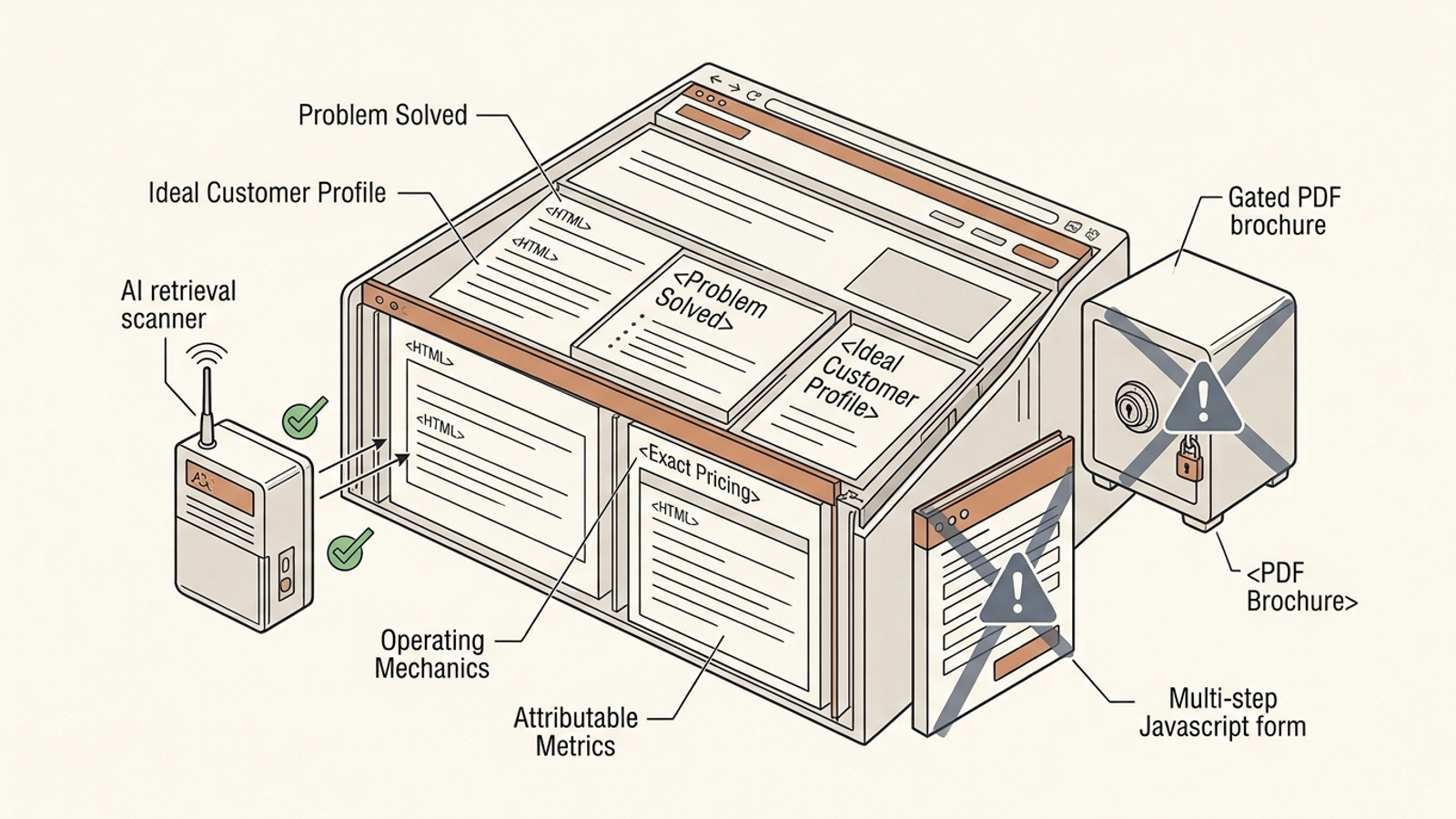
- What problem do you solve? Put the operational outcome in plain language near the top, rather than a promise of “digital transformation.”
- Who is the service for? Name the customers you serve and, where it matters, who should look elsewhere.
- How does it work? Distinguish automation from human oversight instead of calling the whole arrangement “AI-powered.”
- How does pricing work? State the available numbers, minimums, or billing mechanism rather than making a form do all the talking.
- What proof can a buyer inspect? Put specific, attributable evidence on the page when you have it. Do not substitute an impressive-sounding adjective.
An assistant cannot extract a clear offer from jargon that never states one. Neither can a customer. Rewrite for both.
2. Put service and pricing facts where they can be read
A commercial page should state its deliverables and terms in accessible page text, not reserve every useful detail for a brochure or a multi-step lead form. The 1.2% citation figure for whitepapers and gated PDFs is a good reason to question a strategy that hides the answer in a download. Our guide to winning the live fetch in ChatGPT and Perplexity covers the case for clear, server-rendered text over inaccessible presentation.
Take a concrete groas question: “Does groas charge a percentage of ad spend?” The terms on masonandfinch.com give the answer: a flat monthly fee, no setup fees, and month-to-month cancellation. An assistant can find those terms without inventing them. That is more useful than a generic post about how agencies price their work, because it answers the question the buyer actually asked.
3. Write only when you know what the missing answer is
I am not arguing for an empty blog. I am arguing against volume as a substitute for a reason to publish. Run targeted prompt audits across your category. Check whether assistants identify your features, integration limits, and performance benchmarks correctly. If they repeatedly get a consequential fact wrong, publish a clear technical explanation with the primary material you have, give it a descriptive URL, and connect it to your commercial pages.
That is a different assignment from “write fifty questions people might ask.” It has a testable purpose: correct a missing or mistaken answer about the business. If you cannot name the gap, hold the draft. The homepage still needs work.
Who should ignore this take
If you run a publisher network, dictionary hub, or programmatic affiliate directory built to capture huge volumes of broad informational searches, this is not your operating model. Publishing at scale is part of the product.
If you sell a service, a SaaS product, or goods to buyers comparing vendors, the FAQ treadmill is a poor first move. The agency can spend months delivering neat little Q&As while your homepage remains a collection of corporate adjectives and your terms sit behind a contact form. The buyer asks an assistant about you; the assistant has little to work with. The competitor whose core pages state the facts plainly gets the opening you paid the blog to create.
The bill comes due on your core pages
Our 30-day logs recorded 801 verified live-answer fetches for the homepage and four for /blog. That does not tell us every answer an assistant gave, but it tells us enough to reject a bulk FAQ package as the default starting point. At groas, we built autonomous growth sprints for businesses around continuous execution across paid search and AI visibility, with a named strategist and outcome targets. The commercial pages need to explain that offer clearly; fifty definitions cannot do it for them.
Fix the pages assistants actually open when a buyer asks about you before you commission post number fifty. Ignore that order, and you will pay to explain your category while someone else’s site explains why the buyer should hire them.