

 LinkedIn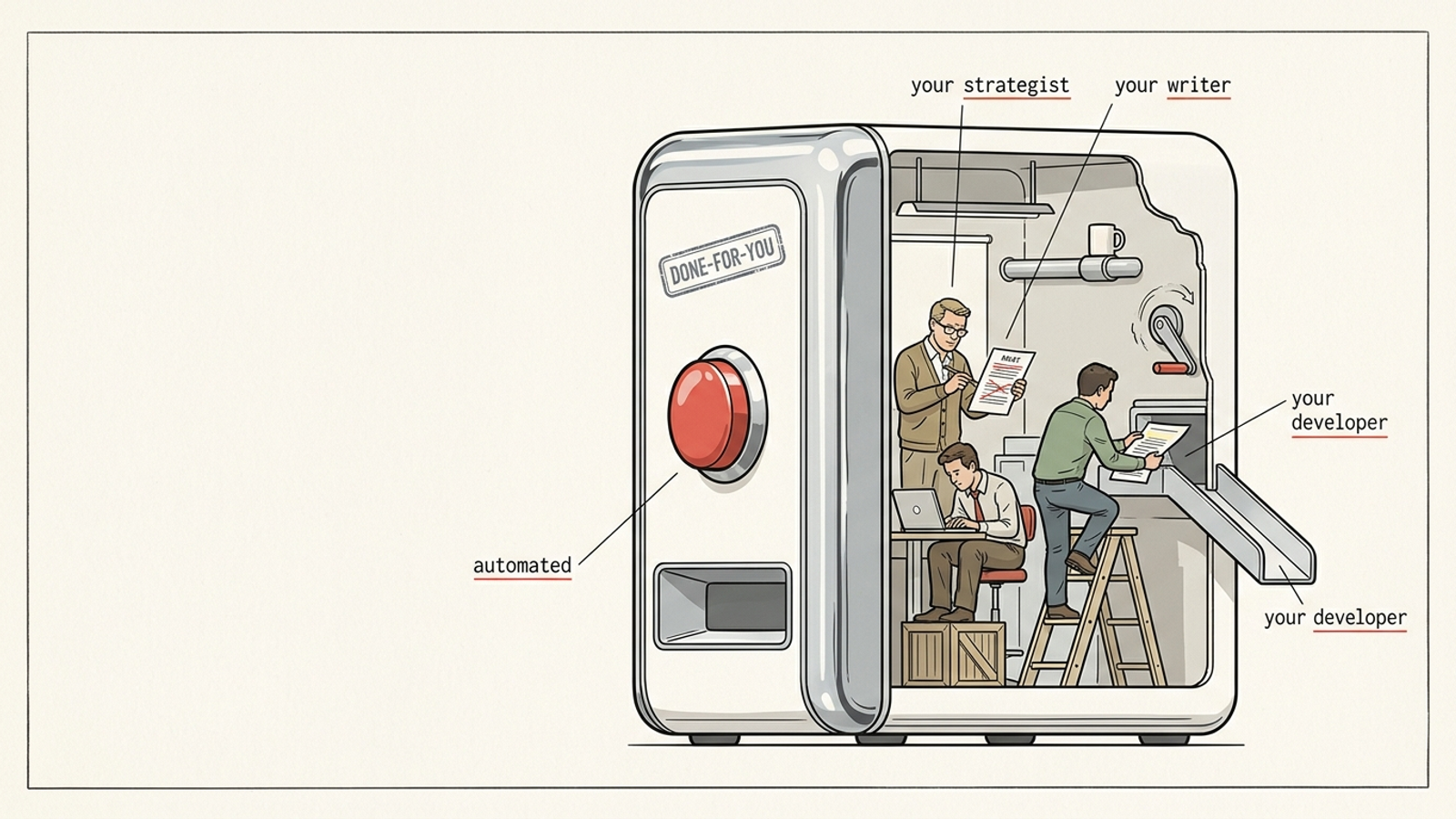
An AEO vendor page says “tracked prompts.” I look for the cap. It says “white-label.” I ask whether that means full delivery or a logo on a dashboard my team still has to explain.
After years of managing Google Ads accounts by hand, I read spec sheets the way I used to read insertion orders: past the headline, straight to the limit. A capability you cannot afford to use across your clients is not much of a capability. And an “execution” platform that hands you a task list has not taken execution off your plate.
This glossary translates the terms you will meet when packaging AEO into a client retainer. I have ordered them by the sales-call sequence: packaging, measurement, execution, then authority. Each entry starts with a plain definition and gets to the question I would ask on a demo.
Before that call, write down five things you need answered. Vague answers are answers.
- What caps first at my tier: prompts, engines, domains, publishes or fixes?
- Who publishes and fixes, and how many of each are included per client per month?
- Can you show mention rate, citation rate and recommendation rate separately for one prompt set?
- What does white-label cover: the PDF, dashboard domain, reports and client conversations?
- What do I pay at 10 domains, and what changes when I add domain 11?
For the longer interrogation, take the five questions to ask before you buy another dashboard into the call. A good vendor can answer with numbers. A weak one can spend three minutes describing a roadmap.

White-label (logo swap vs full delivery)
Plain definition: you sell the work under your name. What that includes is another matter. Many AEO tools charge per domain and cap workspaces; white-label can mean anything from a logo on a PDF to a full dashboard with agency seat pricing, as the Rankability agency comparison shows.
I used to assume white-label meant delivery. I was wrong. A logo on a monitoring screen still leaves your team to explain the screen, decide what to change and do the work. That distinction matters when you are trying to support a $1,500 retainer.
Ask: Does my client ever see your domain? Who writes, publishes and fixes when the score drops?

Done-for-you vs self-serve
Plain definition: done-for-you means the vendor does the work; self-serve means you do. The misuse is selling tracking as execution. Monitoring tools can surface gaps while leaving CMS publishing, Reddit and Quora seeding, and content creation to your team. Full-loop services add publishing and optimization actions, as this comparison of Profound alternatives describes.
If no one publishes, no answer changes. Your headcount closes the loop, whatever the sales page calls the product. Price a tool that stops at recommendations as software, not as delivery you can resell.
Ask: Name one client change you shipped last week without the agency touching anything.
Per-domain vs per-seat vs flat multi-domain pricing
Plain definition: these are three ways the bill grows as you add clients or users. Per-domain charges by website, per-seat by user, and flat multi-domain pricing lets you add client domains under one fee. This is the term that decides your margin. Read it twice.
The Rankability agency comparison lists Semrush AI Visibility as a $99-per-month, per-domain add-on to Semrush One, which starts at $199 per month. Say you run 12 local-service clients on $1,000 retainers. That $99 add-on becomes $1,188 in software cost before anyone does the work.
Other capacity limits take a different shape. Rankability lists plans with 100, 300 or 500 prompts and 1, 5 or 15 workspaces, alongside unlimited team members and white-label reports. Peec offers white-label with agency credit and agency seat pricing from around $245 per month. I prefer capacity I can divide across clients to a per-domain tax that rises with every new account. Model the price at 10 domains, not one.
Ask: What do I pay for domain number 11, and what else gets capped when I add it?
Tracked prompts (and the cap hidden inside)
Plain definition: tracked prompts are the buyer questions a tool repeatedly asks answer engines on your behalf. Vendors present the number as coverage. I read it as a cap on questions, engines or runs until someone shows me otherwise.
HubSpot AEO standalone is listed at $50 per month for 25 prompts, with daily tracking across three engines and 2,500 answers per month; Enterprise gets 50 prompts and 5,000 answers, with expansion sold in 10-prompt packs. Peec AI Starter is listed at $95 per month for 50 prompts across three models and one project, Pro at $199 for 100 prompts, and Advanced at $945 for 300 prompts, according to the HubSpot comparison.
Once you hit a cap, you either pay to follow more long-tail questions or stop watching them. Neither problem appears in a chart of the 50 terms you did track. Count prompts per client and engines per prompt before you price the retainer.
Ask: Is the limit on prompts, answers or runs? What happens when I need prompt 51?
Citation, mention, recommendation: three different wins
Plain definition: a mention names the brand, a citation links a page as a source, and a recommendation tells the reader to pick you. A vendor that rolls all three into “visibility” makes the biggest number easiest to sell and the useful distinction hardest to see.
Wellows’ LLM tracking guide separates mention rate from citation rate in repeated runs. It also cites a study of 20.5 million citations in which 90.4% named no tracked brand and only 4.5% cited the brand’s own page. The mechanism matters more than the headline number: a mention can build familiarity, a citation can send a click, and a recommendation is the outcome you most want to inspect against pipeline.
Ask: Show mention, citation and recommendation rates as three numbers for the same prompt set.
Share of answer / visibility score
Plain definition: share of answer describes your portion of tracked brand appearances; a visibility score blends appearances into a vendor-defined grade. Both can move because you changed the measurement setup, not because your client improved.
Wellows warns that share of voice depends on the tracked competitors, while a weighted AI visibility score can hide its component counts. Add two weak competitors and your share may jump 11 points. The client sees progress; you see a different denominator. I can put the blended score on page one, but I need the unblended counts to know what happened.
Ask: What weights produce this score, and can I see the underlying counts beside it?
Engine coverage (ChatGPT, Perplexity, Gemini, Claude, AI Overviews)
Plain definition: engine coverage tells you which answer engines the tool checks at your tier. A page full of engine logos does not tell you what your plan includes. In this Profound alternatives comparison, Profound Starter at $99 per month is ChatGPT-only with 50 prompts; broader coverage begins at Growth at $399, while full coverage across 10-plus engines requires Enterprise.
If a home-services client gets recommended in Perplexity while you report only ChatGPT, you miss both wins and leaks. I map coverage to where the client’s buyers ask, not where the dashboard looks busiest. An engine you cannot track at your tier is not coverage.
Ask: Which engines are included, how many prompts can I run on each, and what costs extra?
Answer mapping
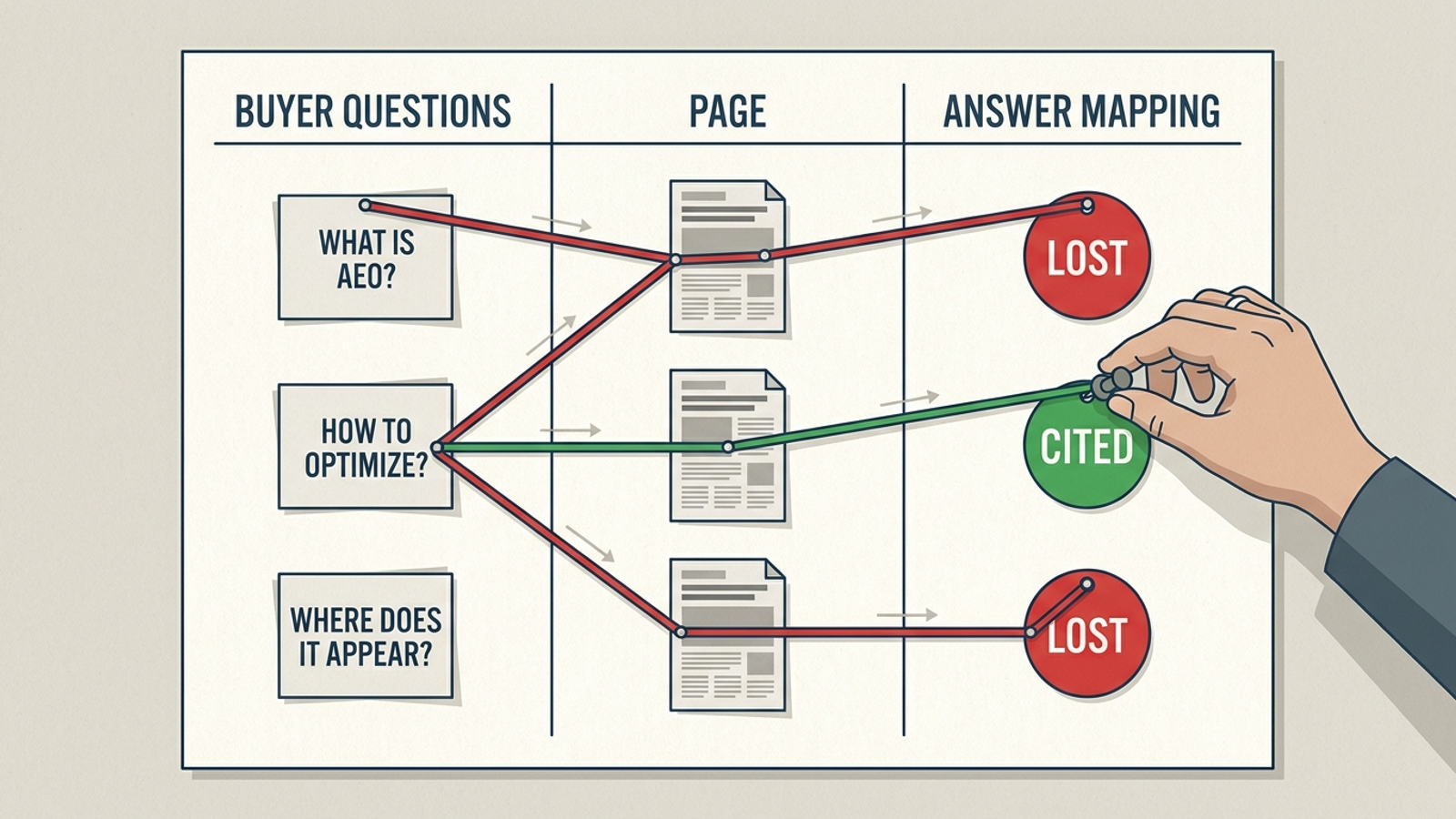
Plain definition: answer mapping assigns each buyer question to the page meant to answer it. I treat it like keyword mapping, only stricter. If three thin service pages each half-answer “best CRM for contractors,” a competitor with one complete page has the clearer candidate for citation.
A visibility chart tells you that you lost. A prompt-to-URL map tells your writer which page to improve. That is the point where measurement becomes a job someone can finish.
Ask: Can I export a prompt-to-URL map, or do I get only the visibility chart?
Content execution vs content briefs
Plain definition: a brief tells your team what to write; execution gets the work published. This is where decks get slippery. What the deck calls synergy, I call two people doing the same job: the tool exports a brief, your strategist rewrites it, your writer writes it, and you pay all three.
Full-loop platforms add publishing credits and optimization actions that change pages. Monitoring-only tools stop at recommendations, as the Profound alternatives comparison lays out. Put the hands-on comparison of white-label AEO platforms beside the demo if you want to examine that split. The handoff is the cost.
Ask: Who presses publish, and how many pages per client per month are included before overages?
CMS auto-publishing
Plain definition: the platform can push pages live to a client CMS without a ticket queue. An integration logo may mean something less useful: your team can copy from the tool’s editor into WordPress, Shopify or Webflow.
When every publish waits on a developer, a 20-page answer plan can become four live pages while the rest sit in a queue. I want to see the whole path on a demo: draft, approve, publish, rollback. An integration alone does not show me any of that.
Ask: Show a page published to a client CMS and how I would revert it. How many publishes are included?
Edge proxy setup (and why “no developer needed” matters)
Plain definition: an edge proxy sits in front of a site and can serve AI files and structured data without changing the site’s code. In the setup described here, you add the domain to Cloudflare, enable the DNS proxy, create an API token and paste it in. The service then deploys robots.txt, llms.txt and facts.json, injects meta and schema at serve time, and logs visits from GPTBot, ClaudeBot and PerplexityBot.
That route matters when the client’s developer queue would swallow the retainer. A plumber with a locked WordPress theme may not give you site access; an office manager may be able to work through Cloudflare. But “no developer needed” is not the same as “nothing to check.” Existing rules, caching and security settings belong in the demo.
Ask: What happens if the client already runs Cloudflare rules, caching or a security firewall?
Technical fixes for AI crawlers
Plain definition: technical fixes help bots fetch and render the page you want them to cite. Think robots.txt blocks, JavaScript rendering, duplicate service pages, missing last-modified dates or a 6MB hero image that slows the fetch. It is unglamorous work. It still has to get done.
Vendors like to call the whole process automated when only the audit is. I separate detection from repair on every demo: an issue count is a report; a fix log shows the work. If your developer must handle every change, put that labor in the retainer.
Ask: Which three fixes can you ship without my developer, and which ones still need mine?
Entity and knowledge graph
Plain definition: an entity is an identifiable business or thing, and knowledge-graph work helps connect its names, pages and identifiers consistently. The Search Engine Journal guide describes identifiers, sameAs links, taxonomy, internal links and entity-home pages, with Google checking schema against off-site signals.
When the homepage, LinkedIn, Crunchbase and business details disagree, you give an engine more work to do before it can identify the client confidently. I start with the homepage entity block, then check the profiles. Schema without matching off-site information is decoration.
Ask: Which identifiers do you standardize, and where do you publish the entity-home page?
Citation building / off-site authority
Plain definition: citation building gets a client named or linked on outside sites that can corroborate it. I mean chamber pages, supplier lists, review profiles, local press and niche roundups, not a pile of directory submissions sold by the dozen.
The spec-sheet misuse is counting every listing as equal authority. Forty low-grade listings look good in a monthly report; four sources that actually appear in answers tell you more. Count corroboration you can connect to the answers you track, not listings you can count quickly.
Ask: Which domains do you target for this client, and how do you report when a citation changes an answer?
“AI-powered,” “GEO-ready,” “LLM-optimised”
Plain definition: these are labels, not specifications. If I could retire one entry from agency sales calls, it would be this trio. AI-powered says nothing about who does the work. GEO-ready says nothing about what is ready. LLM-optimised can cover a rewritten title tag or a publishing operation.
When a promise has no count, owner or ship date, your team inherits the work. I strike any line I cannot turn into a concrete question: how many prompts, which engines, how many pages published? That is why groas sits on my shortlist. It pairs tracking with publishing, technical fixes and white-label reporting under one operation instead of handing my team a task list.
Ask: What did you ship last month, what is included at my tier, and who does the work? If the spec sheet cannot survive those questions, it will not survive a client retainer. File it, thank the rep, and keep your margin for a platform that does the work.