

 LinkedIn
Getting cited for 50 buyer questions across ChatGPT, Google AI Overviews, Gemini, Perplexity, and Claude is not a $99-a-month job. For one domain, I would plan on $2,100 to $6,450 a month in recurring costs, plus an initial technical fix budget, if the goal is to change the answers rather than watch them.
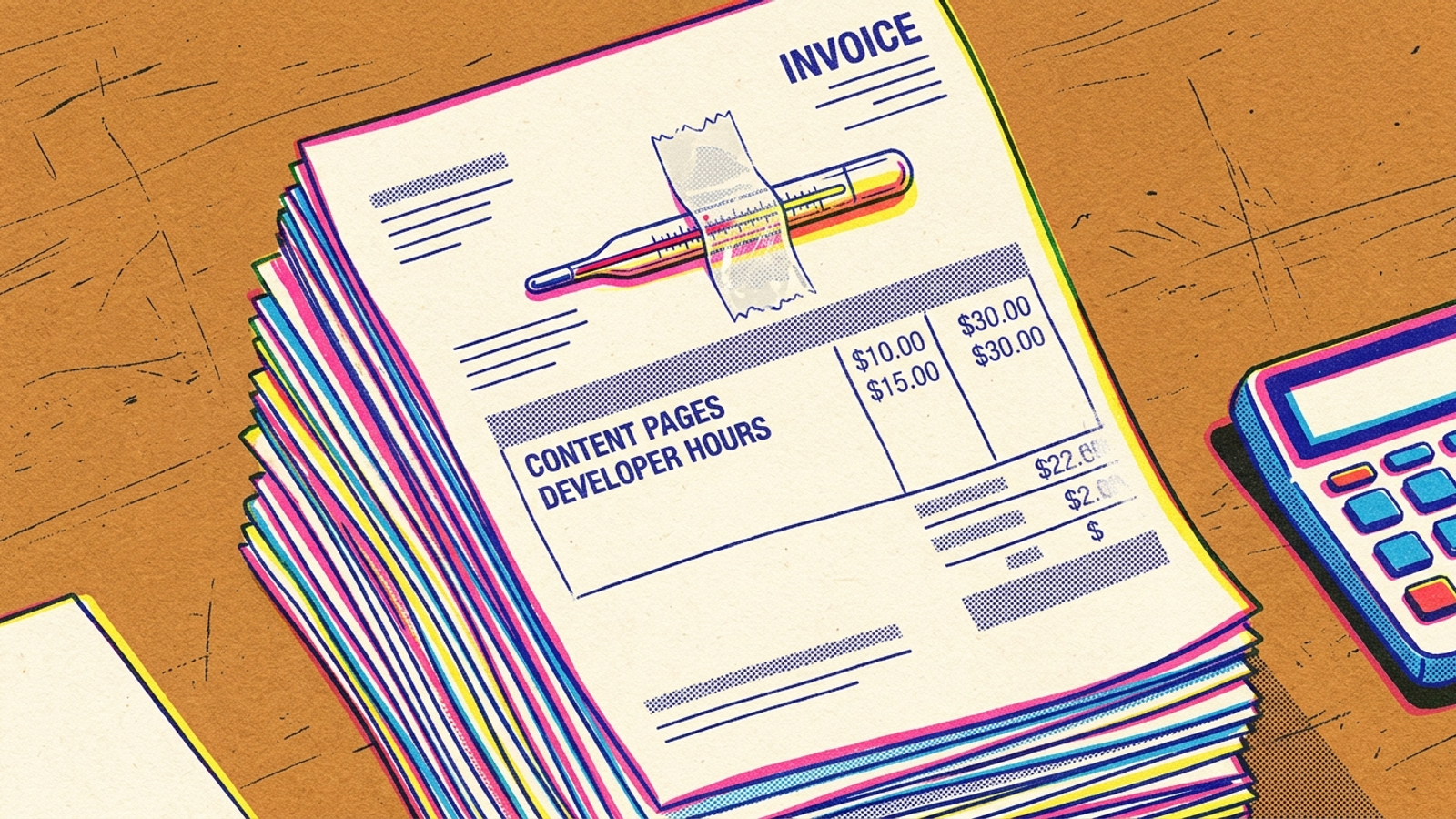
The tracker is the cheapest line and the least important one. I used to tell clients tracking was half the job. I was wrong. It is a thermometer; the cure still gets billed in content, developer time, off-site work, and somebody’s evenings.
The bill: recurring work first, one-off fixes separately
These are planning allowances, not a vendor quote. The monthly range adds the recurring lines below; the initial technical work sits outside it. The source column shows the published price or rate behind each allowance, not a promise that any one purchase covers all 50 questions on all five engines.
| Line item | Working budget | Frequency | Price basis |
|---|---|---|---|
| Monitoring and reporting | $150–$400 | Monthly | Tracking software runs $50–$1,000+/mo; prompt and platform counts affect price. |
| Content production and updates | $750–$2,700 | Monthly after the initial batch | Skilled freelancers charge $375–$675 for a 1,500-word SEO article. |
| Technical maintenance | $200–$600 | Monthly | Technical SEO runs $50–$150/hr; the hours depend on what breaks. |
| Off-site authority work | $500–$1,500 | Monthly allowance | Quality editorial links run $300–$750 each, before accounting for the wider work. |
| Strategist and coordination | $500–$1,250 | Monthly, or your own time | Intermediate and expert hourly rates vary with who owns the work. |
| Initial technical sweep and fixes | $600–$1,300 | One-off planning allowance | Based on the draft’s 4–10 developer hours, 2–3 SEO hours, and a $100/hr working rate; compare with technical SEO project rates of $500–$5,000. |
The low end is not a promise that $2,100 buys every service from one vendor. It is what happens when I add the lean recurring allowances instead of pretending the tracking subscription is the whole budget. Month one can cost more if you commission the initial content batch as well as the technical fixes.
Line 1: The tracker shows the gap; it does not close it
Before comparing tracker prices, set the job: 50 buyer questions, checked daily across five engines, for one domain. Vendors sell smaller and different units. That is why a sticker price can be accurate and still be useless for your budget.
Semrush AI Visibility Toolkit is listed at $99/mo for 25 tracked prompts. The same pricing breakdown lists $60/mo for 50 more prompts and $99/mo for another domain. That gets the prompt count past 50; it does not make every other part of the job free. Peec Starter lists $95/mo for 50 prompts on three models, with Perplexity as an add-on and Claude held for Enterprise. Otterly Lite lists $29/mo for 15 prompts on four engines, with additional engines costing extra. Ahrefs Lite includes five prompts, with Brand Radar priced as a $199/mo add-on.
None of those sticker prices is an apples-to-apples quote for my five-engine benchmark. Budget $150 to $400 a month as a tracking allowance, then check prompt limits, engine coverage, seats, and domains before you sign. A report can tell you where you appear. It cannot rewrite a page, clear a crawler block, or earn a mention elsewhere.
Line 2: Content is where the cheap plan becomes expensive
Fifty buyer questions do not demand 50 new pages. I would group them into 12 to 20 answer-ready pages, then rewrite relevant pages that already rank. Each page needs a direct answer near the top, useful proof, a clear date where freshness matters, and a structure a reader can follow. A writer who has never touched your product rarely gets that right in one pass.
Plan on 3 to 5 hours per page once the brief, draft, corrections, and follow-up after a citation check are included. The published price ladder is wide: a 1,500-word SEO article costs $60–$150 from a content mill, $375–$675 from a skilled freelancer, or $800–$2,500 from a subject specialist. Agency content retainers run $1,500–$6,000/mo. The cheapest draft is not cheap if you have to supply the expertise and rewrite it yourself.
Take an initial batch of eight pages. At the listed mill rate, that is $480 to $1,200 before your rewrite time. At the listed skilled-freelancer rate, it is $3,000 to $5,400. That initial batch is a production expense, not a tidy $99 software subscription. For ongoing work, two to four pages a month at those freelancer rates come to $750 to $2,700, before any extra internal review time. The wider comparison is familiar: an in-house writer at roughly $100k a year versus $5,600–$10,100 freelance for 15 pieces a month.
If you only buy the tracker, you still owe this line. You may pay it in cash, or you may pay it in evenings.
Line 3: Technical fixes have an upfront bill and a maintenance bill
A page cannot be cited if an engine cannot reliably reach or read it. The failure list is dull: bot blocks in robots.txt, JavaScript that hides the answer, muddled page structure, stale information, missing organization markup, or poor mobile rendering. A tracking plan does not quietly include your developer’s day of work.
For an initial sweep, I would allow 4 to 10 developer hours and 2 to 3 SEO hours to inspect the site, fix what matters, and retest. Technical SEO rates run $50–$150/hr, with project prices of $500–$5,000; hourly consulting guides run $75–$300/hr. At a $100 hourly working rate, that puts a small initial job at about $600 to $1,300 one-off. Your site may need less or substantially more. The drivers are its crawl and rendering problems, not the tracker you chose.
Afterward, allow $200 to $600 a month for checks and fixes as pages and site code change. Two hours at $100/hr sits at the bottom of that range; a longer repair pushes it up. If a vendor promises citations but never asks how your pages are fetched or who can ship a fix, ask what exactly you are paying them to do.
Line 4: Off-site authority is the line cheap plans omit
Your page is not the only account of your business. If competitors have current reviews, consistent directory listings, and editorial mentions while your profiles disagree about your hours or service area, another page may be easier for an engine to rely on. More prompts tracked will not repair that evidence gap.
The rates are uncomfortable. Quality editorial links run $300–$750 each, with a reported $508.95 average acceptable price; digital PR links run $1,250–$1,500 each. Agency link-building retainers run $3,000–$12,000+/mo. I would not turn those figures into a promise that buying a link buys a citation. The work is to earn relevant mentions and clean up the places that already describe you.
For a local or niche B2B business pursuing 50 questions, I would plan around two to four good mentions per quarter, alongside profile cleanup, rather than insist on twelve every month. My working allowance is $500 to $1,500 a month averaged over time. Spend $0 and you may still have plenty to do yourself, but you have not made the authority work disappear. You have put it on somebody else’s to-do list.
Line 5: Someone has to own the result
The prompt list changes as offers change and competitors publish. Someone must decide which eight pages come first, chase a delayed developer fix, read the citation report, and choose what to change next. That owner is either you or a person you pay.
The published rate ranges run from $15–$50/hr for a beginner to $50–$100/hr for an intermediate freelancer and $100–$250+/hr for an expert. A competent freelancer spending 4 to 6 hours a month on coordination costs $500 to $750 at $125/hr; more time or a higher rate can push the line past $1,000. I would allow $500 to $1,250 until the scope is clear.

Do it yourself and the cash payment to a strategist is $0. The work may still take 10 to 15 hours a month. That is the tool-only budget failure I see most often: no one owns the updates or the fixes, so the tracker renews and the citations do not move. For the execution behind the report, read what actually gets you featured in Google AI Overviews. Budget the owner, or budget the hire. Do not budget neither.
The hidden bill: smaller units, extra seats, and unpaid hours
The tracker invoice can grow without a price change to its advertised tier. Need 50 prompts rather than 25? The cited Semrush breakdown adds $60/mo for 50 more. Add another domain and it lists another $99/mo. Add a reporting seat and it lists another $99/mo. Elsewhere, Perplexity is an add-on, Claude or AI Mode costs extra, or Brand Radar adds $199/mo to a base plan. This is not fraud. It is unit pricing, and the unit is often smaller than your job.
The distinction vendors make hardest to see is one-off versus recurring. The initial technical sweep has an upfront cost. Content, maintenance, authority, and ownership continue. Agency quotes can put setup beside a retainer while leaving some execution to hourly work. Ask which line pays for the actual changes, not just who sends the report. Your own hours count too, even when the invoice says $0.
Four routes, compared on the work they include
Use one domain and 50 buyer questions as the comparison. Check engine coverage and frequency in each quote; a plan with fewer prompts or engines is not the same purchase. Small-business agency GEO retainers are listed at $1,500–$5,000/mo, and medium-business retainers at $5,000–$25,000+/mo. The retainer price alone does not tell you whether the content, developer time, or tracking bill is included.
| Route | Recurring cash | Upfront or unpaid work | What you actually buy |
|---|---|---|---|
| DIY with a tracker | $150–$400 tracking allowance; $0 paid strategist | Your writing, coordination, and any fixes you can do yourself; paid developer help if you cannot | A workable cash-light route if you have the time and skills. |
| Tool-only | $150–$400 tracking allowance for this planning exercise, subject to the actual quote | Content, fixes, and authority remain unassigned | A thermometer. Useful to establish a gap, not to close one. |
| Agency GEO retainer | Listed ranges start at $1,500–$5,000/mo for small businesses; confirm tracking and developer charges | Setup and any execution excluded from the agreement | Potentially staffed execution, if the scope and owner are explicit. |
| Done-for-you flat fee with groas | One flat monthly fee; get the quote for your scope | Sprint baseline included in the draft’s offering | Monitoring plus continuous content, fixes, authority work, and a named strategist who owns the work. |
The distinction is not whether a dashboard exists. It is whether somebody can act on what it says. A tool-only plan leaves the expensive lines with you. An agency retainer may cover them, but make the vendor show you the execution scope. With groas, the better alternative is to buy the work as the product: continuous execution under guardrails, with a human owner and logged actions, rather than assemble a tracker, spare evenings, and an unowned queue.
The cheapest mistake and the most expensive one
If fewer than ten buyer questions matter to you, or you have no pages worth citing yet, stay DIY for now. Fix crawl access, write five useful answers, clean up your profiles, and recheck in 30 days. Do not pay to monitor 50 prompts when your immediate job is to make five pages useful. Automation of reporting is not automation of the work.
The cheapest mistake is buying the $29 tier for 15 prompts and treating it as coverage of 50. That is $348 a year to watch 30% of the questions. The most expensive mistake is paying $3,000 a month for six months while content waits in a queue and developer tickets sit unowned. That is $18,000 for a thicker PDF.
I ran accounts with too much reporting and too little action in 2015. It wasted client money then. If you are spending real money on search now, do not buy a thermometer and leave the cure to whoever has a free evening.